Kategoriearchiv Brancheninformationen

Wärmetauscher-Wärmerückgewinnungsanlage zum Trocknen von Chrysanthemen und Geißblatt

Funktionsprinzip:
Während des Trocknungsprozesses von Chrysanthemen und Geißblatt wird die entstehende heiße Feuchtigkeit (Abluft) über den Wärmetauscherkern an die Frischluft abgegeben, die in das System eintritt. Auf diese Weise wird die Frischluft vorgewärmt, bevor sie in den Trocknungsbereich gelangt, wodurch der zum Erwärmen der Frischluft erforderliche Energieverbrauch reduziert wird.
Strukturelle Merkmale:
Als Wärmeübertragungsleiter wird üblicherweise hochwertige hydrophile Aluminiumfolie verwendet, die eine gute Wärmeübertragungseffizienz und eine lange Lebensdauer (im Allgemeinen bis zu 8-10 Jahre) aufweist.
Die Kanäle für Frischluft und Abluft sind kreuzförmig angeordnet und durch Aluminiumfolie getrennt, um die Sauberkeit der Frischluft zu gewährleisten und die Übertragung von Gerüchen und Feuchtigkeit zu vermeiden.
Alle Anschlüsse werden mit Dichtmasse abgedichtet und mit Beißkanten-Fließkleber behandelt, um die Luftdichtheit des Wärmetauschers zu gewährleisten.
Leistungsvorteile:
Die Wärmeaustauscheffizienz ist so hoch wie bei 90%, was den Energieverbrauch erheblich senken kann.
Kompakte Struktur, kleines Volumen, geeignet für die Installation und Verwendung bei verschiedenen Gelegenheiten.
Pflegeleicht, leicht zu reinigen, kann direkt mit Leitungswasser oder neutralem Reinigungsmittel gereinigt werden.

Plattenwärmetauscher zur Abwärmerückgewinnung für die Getreidetrocknung

Grain drying is an important step in ensuring safe storage and reducing losses, and the drying heat exchanger plays a crucial role in this process. The grain drying heat exchanger can quickly complete the grain drying process and improve production efficiency through an efficient heat transfer mechanism. Meanwhile, adopting waste heat recovery technology can significantly reduce energy consumption, lower production costs, and reduce carbon emissions, which contributes to environmental protection.
structure type
Tube and tube heat exchanger: Tube and tube heat exchangers, also known as shell and tube heat exchangers, have a simple structure, low manufacturing difficulty, and are easy to clean and maintain. During the process of grain drying, high-temperature flue gas generated by burning coal or other fuels is used as the heat medium.
Plate heat exchanger: Plate heat exchangers are widely used in grain drying due to their simple structure and low manufacturing cost.
Funktionsprinzip
Waste heat recovery: During the drying process of grain, a large amount of heat is generated. The waste heat recovery system improves energy efficiency by collecting this waste heat and transferring it to new dry air.
Preheating air: Some advanced grain drying systems utilize waste heat recovery technology to preheat fresh air, further improving drying efficiency.
Application scope
Plate heat exchangers are suitable for various sizes and types of grain drying equipment, whether it is corn drying towers in large grain storage and logistics centers or grain dryers in small farms.

Plate heat exchanger for waste heat recovery in textile heat setting

During the heat setting process of textiles, a large amount of waste heat energy is usually generated. In order to effectively utilize this waste heat energy, a plate aluminum foil heat exchanger can be used for recycling.
The working principle is as follows:
Plate heat exchanger is an efficient heat exchange device commonly used to transfer heat between two fluids. In the textile heat setting machine, the plate heat exchanger can be placed at the hot air discharge port or flue gas discharge port of the heat setting machine. During the process of contact with the plate, the hot air or flue gas transfers heat to the recovery medium. After absorbing the residual heat energy from hot air or flue gas, the recycling medium can be used to heat water or other fluids for preheating, heating, or other thermal energy requirements in the textile process.
By using plate heat exchangers, textile heat setting machines can recover the waste heat energy from the discharged hot air or flue gas, reduce energy consumption, and improve energy utilization efficiency. This helps to reduce production costs, minimize environmental pollution, and contribute to the sustainable development of the textile industry.

Abwärmerückgewinnungskern für die Granulierung und Trocknung von Gaskesseln

Funktionsprinzip:
Gas boiler granulation and drying waste heat recovery core achieves efficient heat exchange through gas-liquid phase change circulation of working liquid in a closed pipeline. The exhaust gas and fresh air (or air that needs to be heated) exchange heat through the heat exchange core of the plate heat exchanger, and the heat in the exhaust gas is transferred to the fresh air through the heat exchange core, causing the temperature of the fresh air to rise.
Anwendungsgebiete:
This system is widely used in industries such as ceramics, fertilizers, chemicals, feed, water purifiers, and building materials, and is suitable for situations that require high-temperature combustion air or process gases. For example, by using a waste heat recovery system to recover the high-temperature flue gas waste heat discharged from the circular cooler, the energy utilization efficiency of the production process can be improved and energy consumption can be reduced.
In summary, the waste heat recovery core of gas boiler granulation and drying achieves the recovery and reuse of exhaust gas waste heat through an efficient heat transfer mechanism, reducing production costs, improving energy utilization efficiency, and reducing environmental pollution. We can tailor the most suitable waste heat recovery solution based on specific production site conditions and your needs.

Plattenwärmetauscher zur Abwärmerückgewinnung aus Lackier- und Spritzlackierabgasen

Funktionsprinzip:
Der Abwärmetauscher für Abluft aus Lackier- und Brennereiräumen tauscht Energie zwischen Luft und Abluft mittels einer Wärmeleitplatte aus und nutzt die Energie der Abluft zur Vorbehandlung der Frischluft, wodurch Energie zurückgewonnen wird. Frischluft und Abluft sind durch die Wärmeleitplatte vollständig getrennt, um eine gegenseitige Vermischung zu vermeiden und die Reinheit der Frischluft zu gewährleisten.
Produkteinführung:
Unser Abwärmerückgewinnungs-Wärmetauscher ist ein Kreuzstrom-Plattenwärmetauscherkern aus hydrophiler Aluminiumfolie, sauerstoffharzbeschichteter Aluminiumfolie, Edelstahl und weiteren Materialien. Er erreicht eine Wärmeübertragungseffizienz von über 951 TP3T. Eine effiziente Wärmerückgewinnung ist ohne Änderung des bestehenden Beschichtungsprozesses möglich. Das Gerät verbessert nicht nur die Energieeffizienz deutlich, sondern reduziert auch effektiv Abgasemissionen und macht Ihren Produktionsprozess somit umweltfreundlicher und effizienter.
Kernvorteile
Effizient und energiesparend: Unser Gas-Luft-Plattenwärmetauscher nutzt die Verbundphasenwechsel-Wärmeübertragungstechnologie mit einem Wärmeübertragungswirkungsgrad von über 951 TP3T. Er ermöglicht eine effiziente Wärmerückgewinnung ohne Änderung des bestehenden Beschichtungsproduktionsprozesses.
Umweltschutz und Emissionsreduzierung: Durch die Rückgewinnung der Wärmeenergie aus dem Abgas und deren Verwendung zur Frischluftvorwärmung wird die direkte Emission von Abgasen erheblich reduziert, wodurch die Umweltbelastung verringert wird.
Intelligenter Betrieb: Das System läuft vollautomatisch ohne manuelle Überwachung, was Sicherheit und Zuverlässigkeit gewährleistet und die Kosten für die manuelle Wartung erheblich reduziert.
Flexible Anpassung: Wir entwickeln die optimale Abwärmerückgewinnungslösung, abgestimmt auf die Gegebenheiten verschiedener Produktionsstandorte, mit flexibler und bequemer Installation.
Kosten senken: Die durch den Energieverbrauch bedingten Produktionskosten werden deutlich reduziert, die Investitionsrendite verkürzt sich und die Wettbewerbsfähigkeit der Unternehmen wird rasch gesteigert.

Weit verbreitet in der Automobilindustrie, bei der Lackierung von Möbeln, Maschinen und Hochtemperatur-Lackierungen sowie in weiteren Bereichen. Ob Massenproduktion oder Präzisionsfertigung – Gas-Luft-Plattenwärmetauscher bieten Ihnen maßgeschneiderte Energiesparlösungen.

Dampfheizschlangen

  • Structural features
  • it adopts stainless steel tube sleeve & aluminum fin structure, and it is in close contact with steel tubethrough hydraulic expansion tube, which has better heat transfer effect.Made of high quality stainless steel tube, high thermal conductivity and strong corrosion resistance.Professional tube design,low resistance, higher heat transfer.Professional software selection to meet the needs of different users
  • Working conditionSteam pressure ≤0.5MPa, air supply temperature up to 150 degrees;When selecting the product, choose the economic operation wind speed range (1.5m/s-3.5m/s)In this way, it can get good economic operation results.The maximum size of a single size can be 5000mm x 2500mm, which can be assembled when thissize is exceeded.
  • Anwendung
  • Air conditioning ventilation system.
  • Food and medicine drying system.
  • Petrochemicalheat exchange system.
  • Corrosion resistant place

Kreuzstrom-Plattenwärmetauscher

QQ20241015-153001.png

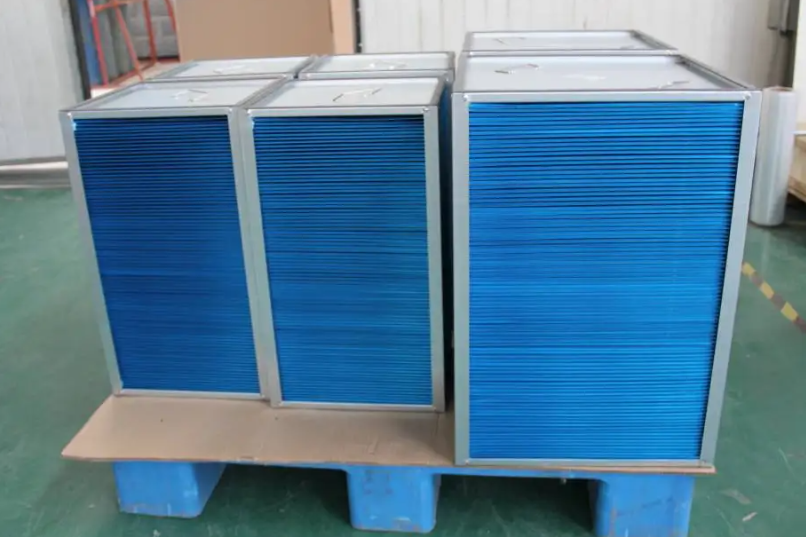
Einleitung: Der Wärmetauscherkern ist ein Kreuzstrom-Wärmetauscherkern, in dem zwei Luftströme mit unterschiedlichen Temperaturen in einem positiven Kreuzstrom fließen und ein Wärmeaustausch zwischen den beiden Flüssigkeiten stattfindet, wobei ihre Kanäle vollständig getrennt sind.

Kreuzstrom-Plattenwärmetauscher können in Lüftungsanlagen als Hauptkomponente der Wärmerückgewinnung eingesetzt werden. Kreuzstrom-Plattenwärmetauscher können auch in Lüftungssystemen eingesetzt werden, indem sie in Luftkanälen als Hauptkomponente der Wärmerückgewinnung installiert werden. Ihre Einbaupositionen können flexibel gewechselt werden.

Cross flow plate heat exchangers

Anwendungsszenarien: Abwärmerückgewinnungslösungen für Beschichtungsmaschinen, Laminiermaschinen usw., Wärmerückgewinnungslösungen zum Trocknen von Gemüse, Nüssen, Garnelenhaut und Trockenfisch, Abwärmerückgewinnung für Lackierräume, energiesparende Technologien zur Abwärmerückgewinnung von Abgasen wie Kessel- und Fabrikstrom.

Die Modulstruktur kann jede beliebige Größen- und Stapelhöhenkombination bereitstellen, um verschiedenen Luftstrom- und Szenenanwendungen gerecht zu werden.

Material: Je nach den Arbeitsbedingungen vor Ort stehen verschiedene Materialien zur Auswahl, wie z. B. hydrophile Aluminiumfolie, Aluminiumfolie aus Epoxidharz, Edelstahl usw.

Cross flow plate heat exchangers

Biopharmaceutical waste heat recovery heat exchanger

The application principle of waste heat recovery equipment in biopharmaceutical enterprises is mainly to transfer the thermal energy in the pharmaceutical factory exhaust gas to the working medium through a heat exchanger, so as to raise its temperature, and then convert this thermal energy into useful energy, such as preheating air, hot water, steam, etc., to avoid energy waste and reduce exhaust gas emissions while protecting the environment.

Advantages of biopharmaceutical waste heat recovery heat exchanger:

Efficient heat transfer

Energy conservation and environmental protection

Easy to maintain

Customizable design

The use of plate heat exchangers for dehumidification and waste heat recovery in the process of biopharmaceutical waste heat recovery can effectively reduce energy consumption, improve efficiency, extend equipment service life, and help meet environmental requirements.

Beschichtungsmaschine, Heizformmaschine, Tunnelofen-Abgaswärmerückgewinnungsgerät

A coating machine is a mechanical device used to evenly apply specific functional adhesives, coatings, inks, etc. onto the surface of a substrate and dry it, with a wide range of applications. For example, printing and packaging coating, textile and building materials anti-corrosion and waterproof coating, automotive sheet metal coating, optical coating for circuit boards, semiconductors, and lithium battery production coating.
The coating process of a coating machine mainly includes three steps: coating, drying, and winding. The drying process generates a large amount of waste heat during the heating process. Therefore, designing an effective waste heat recovery device can effectively reduce the energy consumption of the coating machine, which is important for its energy conservation and environmental protection.
Principle of residual heat recovery of coating machine
The waste heat recovery device of the coating machine uses a heat exchanger to recover waste heat. Using the waste heat gas emitted by the coating machine (coating machine) to preheat the new air, the preheated new air enters the oven through the pipeline, achieving the goal of energy conservation. The heat exchanger achieves waste heat recovery by exchanging heat between the hot air and flue gas generated during the drying process of the coating machine and the recovery medium (such as air, water, or other fluids). Hot air and flue gas flow through the heat exchanger through one side channel, while the recovery medium flows through the other side channel. The plate structure of the heat exchanger increases the surface area for heat transfer and improves the efficiency of heat recovery.
Advantages of Coating Machine Waste Heat Recovery Device
Compact structure, high heat transfer efficiency, and strong adaptability. They are suitable for heat transfer and energy recovery in high temperature, high humidity, and corrosive environments. Through a well-designed waste heat recovery system, lithium battery coating machines can operate more efficiently and reduce their impact on the environment.

Plattenwärmetauscher zur Abwärmerückgewinnung bei der Holztrocknung

Beim konventionellen Holztrocknungsprozess führt die traditionelle Belüftungsmethode zu erheblichen Wärmeverlusten durch den Abtransport von Feuchtigkeit und Abgasen. Das Zwangsbelüftungs- und Abwärmerückgewinnungssystem im Holztrocknungsraum ist eine neue Technologie, die den Trockenluftaustausch im Innen- und Außenbereich bei der Trocknungsproduktion verbessert und Abwärme effektiv zurückgewinnt.
Der Gegenstrom-Plattenwärmetauscher besteht aus hochwertiger hydrophil beschichteter Aluminiumfolie, epoxidharzbeschichteter Aluminiumfolie und anderen Materialien. Die beiden Luftströme treten rückwärts in den Kanal ein, wodurch die Wärmeübertragungsfläche vergrößert wird. Frisch- und Abluft sind vollständig getrennt, um die Übertragung von Gerüchen und Feuchtigkeit zu vermeiden. Schnelle Wärmeleitfähigkeit, keine Sekundärverschmutzung, wodurch Belüftungs- und Wärmerückgewinnungsfunktionen erreicht werden.

Benötigen Sie Hilfe?
de_DEDeutsch