Archive de l'auteur Shaohai

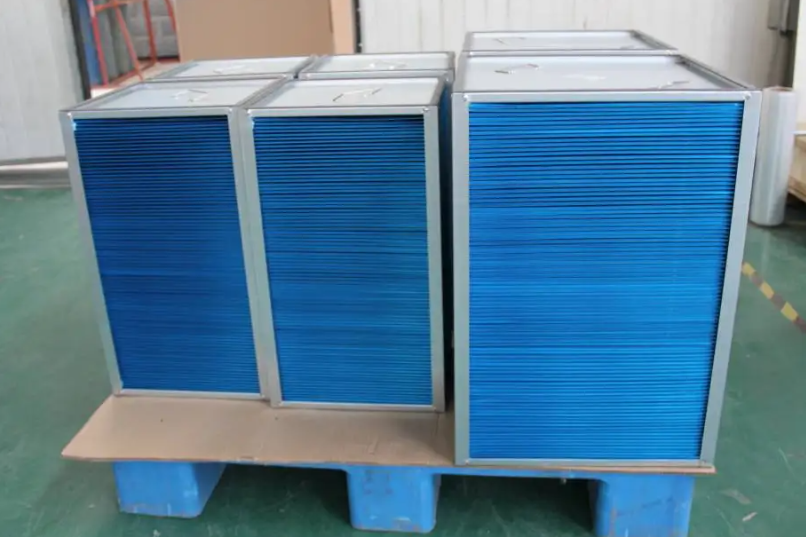
Échangeur de chaleur à plaques pour la récupération de la chaleur perdue des gaz d'échappement de peinture et de peinture par pulvérisation

principe de fonctionnement :
The waste heat recovery heat exchanger for painting and baking room exhaust gas is a device that exchanges energy between air and air through a heat-conducting plate, and uses the energy of exhaust air to pretreat fresh air, thereby achieving the purpose of energy recovery. The fresh air and exhaust air are completely separated by a heat-conducting plate to avoid cross contamination and ensure the cleanliness of the fresh air.
Product Introduction:
Our waste heat recovery heat exchanger is a cross flow plate type heat exchange core, made of hydrophilic aluminum foil, oxygen resin aluminum foil, stainless steel and other materials, with a heat transfer efficiency of over 95%. It can achieve efficient heat recovery without changing the existing coating production process. This device not only significantly improves energy efficiency, but also effectively reduces exhaust emissions, making your production process more environmentally friendly and efficient.
Core advantages
Efficient and energy-saving: Our gas air plate heat exchanger adopts composite phase change heat transfer technology, with a heat transfer efficiency of over 95%. It can achieve efficient heat recovery without changing the existing coating production process.
Environmental protection and emission reduction: By recovering the heat energy from exhaust gas and using it for fresh air preheating, the direct emission of exhaust gas is greatly reduced, reducing the environmental burden.
Intelligent operation: The system runs fully automatically without the need for manual supervision, ensuring safety and reliability, greatly reducing manual maintenance costs.
Flexible customization: Tailored the most suitable waste heat recovery solution according to the conditions of different production sites, with flexible and convenient installation.
Reduce costs: significantly reduce production costs caused by energy consumption, have a short investment return period, and rapidly enhance the market competitiveness of enterprises.

Widely used in automobile manufacturing, furniture baking paint, machine baking paint, high-temperature baking paint and other fields. Whether you are engaged in mass production or precision operations, gas air plate heat exchangers can provide you with customized energy-saving solutions.

serpentins de chauffage à vapeur

  • Caractéristiques structurelles
  • Il adopte un manchon de tube en acier inoxydable et une structure d'ailette en aluminium, et il est en contact étroit avec le tube en acier via un tube d'expansion hydraulique, ce qui a un meilleur effet de transfert de chaleur. Fabriqué en tube d'acier inoxydable de haute qualité, haute conductivité thermique et forte résistance à la corrosion. Conception de tube professionnelle, faible résistance, transfert de chaleur plus élevé. Sélection de logiciels professionnels pour répondre aux besoins des différents utilisateurs
  • État de fonctionnementPression de vapeur ≤ 0,5 MPa, température d'alimentation en air jusqu'à 150 degrés ; Lors de la sélection du produit, choisissez la plage de vitesse du vent de fonctionnement économique (1,5 m/s-3,5 m/s) De cette façon, il peut obtenir de bons résultats de fonctionnement économiques. La taille maximale d'une seule taille peut être de 5 000 mm x 2 500 mm, qui peut être assemblée lorsque cette taille est dépassée.
  • Application
  • Système de ventilation et de climatisation.
  • Système de séchage des aliments et des médicaments.
  • Système d'échange de chaleur pétrochimique.
  • Endroit résistant à la corrosion

Échangeur de chaleur à plaques à flux croisés

QQ20241015-153001.png

Introduction : Le noyau d'échange thermique est un noyau d'échange thermique à flux croisé, dans lequel deux flux d'air de températures différentes circulent en flux croisé positif, et un échange de chaleur se produit entre les deux fluides, leurs canaux étant complètement séparés.

Les échangeurs de chaleur à plaques à flux croisés peuvent être utilisés dans les centrales de traitement d'air comme composant principal de la récupération de chaleur. Ils peuvent également être utilisés dans les systèmes de ventilation, installés dans les conduits d'air comme composant principal de la section de récupération de chaleur, et leur position d'installation est facilement modulable.

Cross flow plate heat exchangers

Scénarios d'application : Solutions de récupération de chaleur résiduelle pour les machines de revêtement, les machines à laminer, etc., solutions de récupération de chaleur pour le séchage des légumes, des noix, des peaux de crevettes et du poisson séché, récupération de chaleur résiduelle pour les salles de cuisson de peinture, technologies d'économie d'énergie pour la récupération de chaleur résiduelle des gaz d'échappement tels que l'électricité des chaudières et des usines.

La structure modulaire permet de combiner différentes tailles et hauteurs d'empilement afin de répondre à diverses applications en matière de flux d'air et d'environnement.

Matériaux : En fonction des conditions de travail sur site, différents matériaux peuvent être sélectionnés, tels que la feuille d'aluminium hydrophile, la feuille d'aluminium en résine époxy, l'acier inoxydable, etc.

Cross flow plate heat exchangers

MariaDBCommercial ceiling heat pump type fresh air ventilator series

产品特点

Product Features1

The air volume range is 1000-10000 m³/h, in terms of ventilation and exchange functions, add air purification, energy recovery, refrigeration and heating functions to maximize the recovery of cold and heat in the exhaust. It is suitable for laboratories, computer rooms, cinemas and theaters, shopping malls, supermarkets, hospitals, hotels, offices, schools, nursing homes and any other public places.

具备双向换气、空气净化( G4+F5过滤)、全热板式一次能量回收,热泵系统二次能量回收功能,可达到 85% 能量回收效果。过滤器检修灵活,可选侧面(压机侧对面)或底部(压机侧对面下部)抽拉检修。

Equipped with bidirectional air exchange, air purification (G4+F5 filtration), total heat plate primary energy recovery, and heat pump system secondary energy recovery functions, it can achieve 85% energy recovery effect. The filter maintenance is easy, with options for side (opposite the press side) or bottom (opposite the press side and lower) pull-out maintenance.

液晶显示控制,多重保护,操作方便;具有高低压保护,排风温度保护,压缩机启动延迟保护,过载及相序保护等确保设备运行安全可靠。

LCD display control, multiple protections, easy operation; Equipped with high and low pressure protection, exhaust temperature protection, compressor start delay protection, overload and phase sequence protection to ensure safe and reliable equipment operation.

Filtre à air à volet roulant automatique

Automatic rolling shutter air filter is an air pre filtration and dust removal equipment that uses special chemical fiber rolls as the filtering medium, and uses the pressure difference before and after the filter as the sensing signal to automatically control the replacement of filter materials.

The automatic rolling shutter air filter is equipped with synthetic fiber filter material. The thickness is 8-20mm. The main raw material of the filter material is polyester fiber. The structural form often presents a density gradient arrangement and combination. This synthetic fiber composite filter material has the characteristics of good comprehensive ventilation and dust removal performance, high strength, etc. It is non-toxic, odorless, non-volatile, non irritating to the skin, and easy to operate.

The automatic rolling shutter air filter has the advantages of simple structure, low operating cost, and convenient use. It can be used in various intake purification places, especially for air purification of high air volume and low air pressure intake systems, such as in front of ventilation equipment and air conditioning units, and at the intake end of blower rooms.

Échangeur de chaleur pour la récupération de chaleur résiduelle biopharmaceutique

Le principe d'application des équipements de récupération de chaleur résiduelle dans les entreprises biopharmaceutiques consiste principalement à transférer l'énergie thermique des gaz d'échappement de l'usine pharmaceutique au fluide de travail via un échangeur de chaleur, afin d'en augmenter la température, puis à convertir cette énergie thermique en énergie utile, telle que le préchauffage de l'air, de l'eau chaude, de la vapeur, etc., afin d'éviter le gaspillage d'énergie et de réduire les émissions de gaz d'échappement tout en protégeant l'environnement.

Avantages de l'échangeur de chaleur à récupération de chaleur résiduelle biopharmaceutique :

Transfert de chaleur efficace

Économies d'énergie et protection de l'environnement

Facile à entretenir

Conception personnalisable

L'utilisation d'échangeurs de chaleur à plaques pour la déshumidification et la récupération de la chaleur résiduelle dans le processus de récupération de la chaleur résiduelle biopharmaceutique peut réduire efficacement la consommation d'énergie, améliorer l'efficacité, prolonger la durée de vie des équipements et contribuer à satisfaire aux exigences environnementales.

machine de revêtement, machine de formage à chaud, dispositif de récupération de chaleur des gaz d'échappement d'un four tunnel

A coating machine is a mechanical device used to evenly apply specific functional adhesives, coatings, inks, etc. onto the surface of a substrate and dry it, with a wide range of applications. For example, printing and packaging coating, textile and building materials anti-corrosion and waterproof coating, automotive sheet metal coating, optical coating for circuit boards, semiconductors, and lithium battery production coating.
The coating process of a coating machine mainly includes three steps: coating, drying, and winding. The drying process generates a large amount of waste heat during the heating process. Therefore, designing an effective waste heat recovery device can effectively reduce the energy consumption of the coating machine, which is important for its energy conservation and environmental protection.
Principle of residual heat recovery of coating machine
The waste heat recovery device of the coating machine uses a heat exchanger to recover waste heat. Using the waste heat gas emitted by the coating machine (coating machine) to preheat the new air, the preheated new air enters the oven through the pipeline, achieving the goal of energy conservation. The heat exchanger achieves waste heat recovery by exchanging heat between the hot air and flue gas generated during the drying process of the coating machine and the recovery medium (such as air, water, or other fluids). Hot air and flue gas flow through the heat exchanger through one side channel, while the recovery medium flows through the other side channel. The plate structure of the heat exchanger increases the surface area for heat transfer and improves the efficiency of heat recovery.
Advantages of Coating Machine Waste Heat Recovery Device
Compact structure, high heat transfer efficiency, and strong adaptability. They are suitable for heat transfer and energy recovery in high temperature, high humidity, and corrosive environments. Through a well-designed waste heat recovery system, lithium battery coating machines can operate more efficiently and reduce their impact on the environment.

échangeur de chaleur à plaques pour la récupération de la chaleur résiduelle du séchage du bois

Dans le procédé de séchage conventionnel du bois, la ventilation traditionnelle entraîne d'importantes pertes de chaleur dues à l'évacuation de l'humidité et des gaz d'échappement. Le système de ventilation forcée et de récupération de chaleur résiduelle dans les séchoirs à bois est une technologie novatrice qui améliore le renouvellement de l'air entre l'intérieur et l'extérieur lors du séchage et permet de récupérer efficacement la chaleur perdue.
L'échangeur de chaleur à plaques à contre-courant utilise des matériaux de haute qualité, tels que des feuilles d'aluminium revêtues d'un revêtement hydrophile ou de résine époxy. Les deux flux d'air pénètrent en sens inverse dans le canal, augmentant ainsi la surface d'échange thermique. L'air frais et l'air extrait sont parfaitement séparés, évitant la transmission d'odeurs et d'humidité. Offrant une conductivité thermique rapide et sans pollution secondaire, il assure à la fois la ventilation et la récupération de chaleur.

Échangeur de chaleur à plaques, pompe à chaleur, échangeur de chaleur de séchage, ventilateur d'air frais industriel, équipement de récupération de chaleur

Product Introduction:
Plate heat exchanger is a detachable energy recovery heat exchange device composed of multiple corrugated heat transfer plates. The heat exchange core is made of hydrophilic aluminum foil, oxygen resin aluminum foil, stainless steel and other materials. The air flows in a cross flow manner, and the fresh exhaust is completely separated to avoid the transmission of any odor and moisture.

Product features:

  1. Using hydrophilic coated aluminum foil as the heat transfer conductor, processed by special technology, it has the characteristics of high heat transfer efficiency, easy maintenance, and long service life.
  2. Epoxy resin aluminum foil can be used, which is corrosion-resistant and suitable for special occasions.
  3. Multiple specifications, sizes, and spacing (3-12mm) are available for selection.
  4. Modular structure, capable of providing combinations of cross-sections of any size and plate stacking thickness, with no moving parts and low equipment maintenance costs.
  5. Compact structure, small volume, suitable for various occasions.
  6. Flexible assembly: The combination form of plate heat exchangers can be reasonably selected according to the size of the usage and installation site space, as well as the operating conditions.

Application areas:
Widely used in ventilation, energy recovery, cooling, heating, dehumidification, and waste heat recovery industries such as HVAC, telecommunications, power, textile, automotive, food, medical, agriculture, animal husbandry, baking, drying, welding, and boilers.
Heat pump system: Plate heat exchangers are widely used in air source heat pump systems, suitable for household and small commercial projects.
Industrial sector: Suitable for large-scale heat exchange in industrial production, such as chemical, food processing, energy and power industries.
Ground source heat pump system: suitable for ground source heat pump systems, with high heat transfer efficiency.
Seawater desalination: suitable for seawater desalination process, corrosion-resistant and high-temperature resistant.

ÉCHANGEURS DE REFROIDISSEMENT POUR CENTRES DE DONNÉES

The application of cooling heat exchangers in data centers is an important component of energy efficiency management in data centers. Through efficient thermal management technology, energy consumption is significantly reduced and system performance is improved.

air-to-air heat exchanger
The function of plate heat exchanger
Improving energy efficiency: Plate heat exchangers play a crucial role in data center cooling systems. Through an efficient heat exchange process, plate heat exchangers can effectively transfer the heat generated by servers to the cooling water, which is then released into the atmosphere through the cooling tower. This efficient heat exchange process not only improves the energy efficiency of data centers, but also reduces energy consumption and operating costs.
Optimize temperature control: Plate heat exchangers can accurately control the temperature and humidity inside data centers, ensuring that server equipment operates in a suitable environment. By adjusting the flow rate and temperature of cooling water, plate heat exchangers can meet the cooling needs of different data centers, ensuring the stable operation and efficient performance of server equipment.
Energy saving and environmental protection: The use of plate heat exchangers helps reduce the impact of data centers on the environment. By using environmentally friendly materials and energy-saving technologies, plate heat exchangers can reduce energy consumption and emissions, in line with the concept of sustainable development. Meanwhile, the efficient heat exchange process of plate heat exchangers also reduces waste of natural resources, providing strong support for the green operation of data centers.
Flexible and reliable: Plate heat exchangers have the advantages of compact structure, small footprint, and easy installation, making them widely used in space limited places such as data centers. At the same time, the design and manufacturing of plate heat exchangers have undergone strict quality control and testing verification, ensuring their long-term stable and reliable operational performance.

Besoin d'aide?
fr_BEFrançais de Belgique