Arquivo do autor shaohai

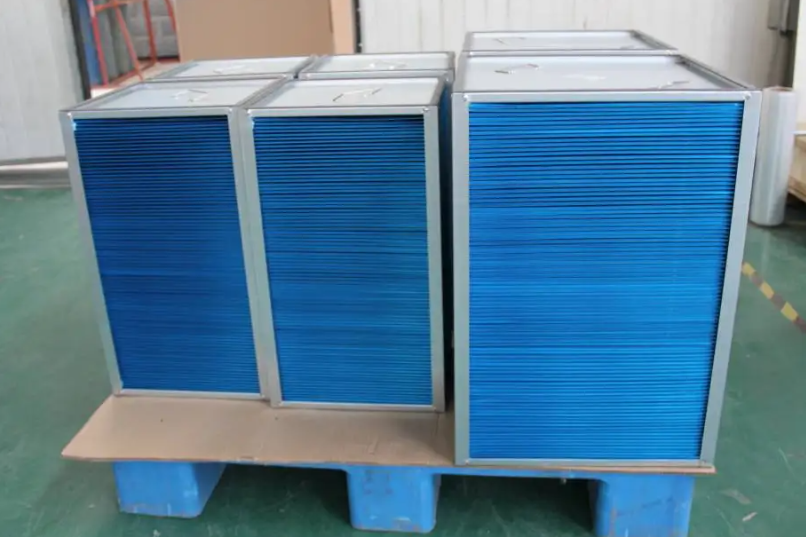
Trocador de calor de placas para recuperação de calor residual de gases de exaustão de pintura e pulverização.

princípio de funcionamento:
O trocador de calor para recuperação de calor residual de gases de exaustão em salas de pintura e secagem é um dispositivo que realiza a troca de energia entre o ar e o ar de exaustão através de uma placa condutora de calor, utilizando a energia do ar de exaustão para pré-tratar o ar fresco, atingindo assim o objetivo de recuperação de energia. O ar fresco e o ar de exaustão são completamente separados por uma placa condutora de calor para evitar contaminação cruzada e garantir a pureza do ar fresco.
Apresentação do produto:
Nosso trocador de calor para recuperação de calor residual é um trocador de calor de placas de fluxo cruzado com núcleo composto por folha de alumínio hidrofílica, folha de alumínio com resina oxigenada, aço inoxidável e outros materiais, apresentando uma eficiência de transferência de calor superior a 95%. Ele permite a recuperação eficiente de calor sem a necessidade de alterar o processo de revestimento existente. Este dispositivo não só melhora significativamente a eficiência energética, como também reduz eficazmente as emissões de gases de escape, tornando seu processo produtivo mais ecológico e eficiente.
Principais vantagens
Eficiente e econômico: Nosso trocador de calor de placas gás-ar adota a tecnologia de transferência de calor por mudança de fase composta, com uma eficiência de transferência de calor superior a 95%. Ele permite uma recuperação de calor eficiente sem alterar o processo de produção de revestimento existente.
Proteção ambiental e redução de emissões: Ao recuperar a energia térmica dos gases de escape e utilizá-la para o pré-aquecimento do ar fresco, a emissão direta de gases de escape é significativamente reduzida, diminuindo o impacto ambiental.
Operação inteligente: O sistema funciona de forma totalmente automática, sem necessidade de supervisão manual, garantindo segurança e confiabilidade, e reduzindo significativamente os custos de manutenção manual.
Personalização flexível: Adaptamos a solução de recuperação de calor residual mais adequada às condições de diferentes locais de produção, com instalação flexível e prática.
Redução de custos: reduzir significativamente os custos de produção causados pelo consumo de energia, ter um curto período de retorno do investimento e aumentar rapidamente a competitividade das empresas no mercado.

Amplamente utilizados na fabricação de automóveis, pintura de móveis, pintura de máquinas, pintura de alta temperatura e outros setores. Seja qual for a sua área de atuação, produção em massa ou operações de precisão, os trocadores de calor de placas a gás e ar oferecem soluções personalizadas para economia de energia.

Serpentinas de aquecimento a vapor

  • Structural features
  • it adopts stainless steel tube sleeve & aluminum fin structure, and it is in close contact with steel tubethrough hydraulic expansion tube, which has better heat transfer effect.Made of high quality stainless steel tube, high thermal conductivity and strong corrosion resistance.Professional tube design,low resistance, higher heat transfer.Professional software selection to meet the needs of different users
  • Working conditionSteam pressure ≤0.5MPa, air supply temperature up to 150 degrees;When selecting the product, choose the economic operation wind speed range (1.5m/s-3.5m/s)In this way, it can get good economic operation results.The maximum size of a single size can be 5000mm x 2500mm, which can be assembled when thissize is exceeded.
  • Aplicativo
  • Air conditioning ventilation system.
  • Food and medicine drying system.
  • Petrochemicalheat exchange system.
  • Corrosion resistant place

Trocador de calor de placas de fluxo cruzado

QQ20241015-153001.png

Introduction: The heat exchange core is a cross flow heat exchange core, in which two streams of air with different temperatures flow in a positive cross flow, and heat exchange occurs between the two fluids, with their channels completely separated.

Cross flow plate heat exchangers can be applied to air handling units as the main component of heat recovery. Cross flow plate heat exchangers can also be applied to ventilation systems, installed in air ducts as the main component of the heat recovery section, and their installation positions can be flexibly switched.

Cross flow plate heat exchangers

Application scenarios: Waste heat recovery solutions for coating machines, laminating machines, etc., heat recovery solutions for drying vegetables, nuts, shrimp skin, and dried fish, waste heat recovery for paint baking rooms, energy-saving technologies for waste heat recovery of exhaust gases such as boiler and factory electricity.

The module structure can provide any size and stacking height combination to meet various airflow and scene applications.

Material: According to the on-site working conditions, various materials are available for selection, such as hydrophilic aluminum foil, epoxy resin aluminum foil, stainless steel, etc.

Cross flow plate heat exchangers

Série de ventiladores de ar fresco tipo bomba de calor de teto comercial MariaDB

产品特点

Características do produto1

A vazão de ar varia de 1000 a 10000 m³/h. Além das funções de ventilação e troca de ar, o sistema também oferece purificação do ar, recuperação de energia, refrigeração e aquecimento, maximizando o aproveitamento do frio e do calor no ar expelido. É ideal para laboratórios, salas de informática, cinemas e teatros, shoppings, supermercados, hospitais, hotéis, escritórios, escolas, casas de repouso e quaisquer outros locais públicos.

具备双向换气、空气净化( G4+F5过滤)、全热板式一次能量回收,热泵系统二次能量回收功能,可达到 85% 能量回收效果。过滤器检修灵活,可选侧面(压机侧对面)或底部(压机侧对面下部)抽拉检修。

Equipado com sistema de troca de ar bidirecional, purificação do ar (filtragem G4+F5), recuperação total de energia primária por placa de aquecimento e recuperação de energia secundária por sistema de bomba de calor, o equipamento atinge o efeito de recuperação de energia 85%. A manutenção do filtro é facilitada, com opções de remoção lateral (lado oposto ao da prensa) ou inferior (lado oposto ao da prensa e mais abaixo).

液晶显示控制,多重保护,操作方便;具有高低压保护,排风温度保护,压缩机启动延迟保护,过载及相序保护等确保设备运行安全可靠。

Controle por display LCD, múltiplas proteções, operação fácil; Equipado com proteção contra alta e baixa pressão, proteção contra temperatura de exaustão, proteção contra atraso na partida do compressor, proteção contra sobrecarga e inversão de fase para garantir a operação segura e confiável do equipamento.

Filtro de ar de persiana automática

Automatic rolling shutter air filter is an air pre filtration and dust removal equipment that uses special chemical fiber rolls as the filtering medium, and uses the pressure difference before and after the filter as the sensing signal to automatically control the replacement of filter materials.

The automatic rolling shutter air filter is equipped with synthetic fiber filter material. The thickness is 8-20mm. The main raw material of the filter material is polyester fiber. The structural form often presents a density gradient arrangement and combination. This synthetic fiber composite filter material has the characteristics of good comprehensive ventilation and dust removal performance, high strength, etc. It is non-toxic, odorless, non-volatile, non irritating to the skin, and easy to operate.

The automatic rolling shutter air filter has the advantages of simple structure, low operating cost, and convenient use. It can be used in various intake purification places, especially for air purification of high air volume and low air pressure intake systems, such as in front of ventilation equipment and air conditioning units, and at the intake end of blower rooms.

Biopharmaceutical waste heat recovery heat exchanger

The application principle of waste heat recovery equipment in biopharmaceutical enterprises is mainly to transfer the thermal energy in the pharmaceutical factory exhaust gas to the working medium through a heat exchanger, so as to raise its temperature, and then convert this thermal energy into useful energy, such as preheating air, hot water, steam, etc., to avoid energy waste and reduce exhaust gas emissions while protecting the environment.

Advantages of biopharmaceutical waste heat recovery heat exchanger:

Efficient heat transfer

Energy conservation and environmental protection

Easy to maintain

Customizable design

The use of plate heat exchangers for dehumidification and waste heat recovery in the process of biopharmaceutical waste heat recovery can effectively reduce energy consumption, improve efficiency, extend equipment service life, and help meet environmental requirements.

Coating machine, heating shaping machine, tunnel furnace exhaust gas heat recovery device

A coating machine is a mechanical device used to evenly apply specific functional adhesives, coatings, inks, etc. onto the surface of a substrate and dry it, with a wide range of applications. For example, printing and packaging coating, textile and building materials anti-corrosion and waterproof coating, automotive sheet metal coating, optical coating for circuit boards, semiconductors, and lithium battery production coating.
The coating process of a coating machine mainly includes three steps: coating, drying, and winding. The drying process generates a large amount of waste heat during the heating process. Therefore, designing an effective waste heat recovery device can effectively reduce the energy consumption of the coating machine, which is important for its energy conservation and environmental protection.
Principle of residual heat recovery of coating machine
The waste heat recovery device of the coating machine uses a heat exchanger to recover waste heat. Using the waste heat gas emitted by the coating machine (coating machine) to preheat the new air, the preheated new air enters the oven through the pipeline, achieving the goal of energy conservation. The heat exchanger achieves waste heat recovery by exchanging heat between the hot air and flue gas generated during the drying process of the coating machine and the recovery medium (such as air, water, or other fluids). Hot air and flue gas flow through the heat exchanger through one side channel, while the recovery medium flows through the other side channel. The plate structure of the heat exchanger increases the surface area for heat transfer and improves the efficiency of heat recovery.
Advantages of Coating Machine Waste Heat Recovery Device
Compact structure, high heat transfer efficiency, and strong adaptability. They are suitable for heat transfer and energy recovery in high temperature, high humidity, and corrosive environments. Through a well-designed waste heat recovery system, lithium battery coating machines can operate more efficiently and reduce their impact on the environment.

Wood drying waste heat recovery plate heat exchanger

In the conventional drying process of wood, the traditional ventilation method results in significant heat loss due to the removal of moisture and exhaust gas. The forced ventilation and waste heat recovery system in the wood drying room is a new technology that improves the indoor and outdoor dry wet air exchange process in drying production and effectively recovers waste heat.
The counterflow plate heat exchanger adopts high-quality hydrophilic coated aluminum foil, epoxy resin coated aluminum foil and other materials. The two air streams enter the channel in reverse, increasing the heat transfer area. The fresh air and exhaust air are completely separated to avoid the transmission of odors and moisture. Fast thermal conductivity, no secondary pollution, achieving ventilation and heat recovery functions.

Plate heat exchanger, heat pump, drying heat exchanger, industrial fresh air fan, heat recovery equipment

Apresentação do produto:
Plate heat exchanger is a detachable energy recovery heat exchange device composed of multiple corrugated heat transfer plates. The heat exchange core is made of hydrophilic aluminum foil, oxygen resin aluminum foil, stainless steel and other materials. The air flows in a cross flow manner, and the fresh exhaust is completely separated to avoid the transmission of any odor and moisture.

Product features:

  1. Using hydrophilic coated aluminum foil as the heat transfer conductor, processed by special technology, it has the characteristics of high heat transfer efficiency, easy maintenance, and long service life.
  2. Epoxy resin aluminum foil can be used, which is corrosion-resistant and suitable for special occasions.
  3. Multiple specifications, sizes, and spacing (3-12mm) are available for selection.
  4. Modular structure, capable of providing combinations of cross-sections of any size and plate stacking thickness, with no moving parts and low equipment maintenance costs.
  5. Compact structure, small volume, suitable for various occasions.
  6. Flexible assembly: The combination form of plate heat exchangers can be reasonably selected according to the size of the usage and installation site space, as well as the operating conditions.

Áreas de aplicação:
Widely used in ventilation, energy recovery, cooling, heating, dehumidification, and waste heat recovery industries such as HVAC, telecommunications, power, textile, automotive, food, medical, agriculture, animal husbandry, baking, drying, welding, and boilers.
Heat pump system: Plate heat exchangers are widely used in air source heat pump systems, suitable for household and small commercial projects.
Industrial sector: Suitable for large-scale heat exchange in industrial production, such as chemical, food processing, energy and power industries.
Ground source heat pump system: suitable for ground source heat pump systems, with high heat transfer efficiency.
Seawater desalination: suitable for seawater desalination process, corrosion-resistant and high-temperature resistant.

DATA CENTER COOLING EXCHANGERS

The application of cooling heat exchangers in data centers is an important component of energy efficiency management in data centers. Through efficient thermal management technology, energy consumption is significantly reduced and system performance is improved.

air-to-air heat exchanger
The function of plate heat exchanger
Improving energy efficiency: Plate heat exchangers play a crucial role in data center cooling systems. Through an efficient heat exchange process, plate heat exchangers can effectively transfer the heat generated by servers to the cooling water, which is then released into the atmosphere through the cooling tower. This efficient heat exchange process not only improves the energy efficiency of data centers, but also reduces energy consumption and operating costs.
Optimize temperature control: Plate heat exchangers can accurately control the temperature and humidity inside data centers, ensuring that server equipment operates in a suitable environment. By adjusting the flow rate and temperature of cooling water, plate heat exchangers can meet the cooling needs of different data centers, ensuring the stable operation and efficient performance of server equipment.
Economia de energia e proteção ambiental: The use of plate heat exchangers helps reduce the impact of data centers on the environment. By using environmentally friendly materials and energy-saving technologies, plate heat exchangers can reduce energy consumption and emissions, in line with the concept of sustainable development. Meanwhile, the efficient heat exchange process of plate heat exchangers also reduces waste of natural resources, providing strong support for the green operation of data centers.
Flexible and reliable: Plate heat exchangers have the advantages of compact structure, small footprint, and easy installation, making them widely used in space limited places such as data centers. At the same time, the design and manufacturing of plate heat exchangers have undergone strict quality control and testing verification, ensuring their long-term stable and reliable operational performance.

Precisar de ajuda?
pt_BRPortuguês do Brasil